On this page
Short answer: A tummy tuck scar is usually ready for camouflage tattooing once it has fully matured, which often takes 12 to 18 months after surgery. A ready scar is flat, soft, pale and no longer pink, itchy or changing. Your surgeon should confirm healing is complete, and an artist decides final suitability in person.
Why can’t you camouflage a tummy tuck scar right away?
An abdominoplasty incision closes within weeks, but the scar underneath keeps changing for much longer. During that time the body is laying down and reorganizing collagen, the scar’s blood supply is gradually reducing, and its color and thickness are still moving. The American Society of Plastic Surgeons notes that a tummy tuck scar may take several months to a year to fade as much as it will, and a clinical review in StatPearls puts general scar maturation at about 12 to 18 months.
Tattooing into tissue that is still remodeling causes two practical problems. First, the color you match today may not match in six months, because the scar itself will keep lightening. Second, immature scar tissue tends to hold pigment unevenly, which can leave a patchy result that takes more work to correct. Waiting is not a formality; it is what gives camouflage its best chance.
What does a tummy tuck scar go through as it heals?
Every body heals on its own schedule, and your surgeon’s instructions always come first. This general timeline shows why patience pays off:
| Time after surgery | What the scar typically looks like | Camouflage? |
|---|---|---|
| First 6 weeks | Incision closing, sutures or tape, swelling and tenderness | No. Follow surgical aftercare only. |
| 6 weeks to 6 months | Often at its pinkest, reddest or most raised; may itch or feel tight | No. The scar is still very active. |
| 6 to 12 months | Gradually flattening and lightening; color still settling | Usually too early. A consultation can help plan ahead. |
| 12 to 18 months and beyond | Often pale, soft and stable | Often the right time, if the scar meets the checklist below. |
Some scars are stable sooner, and some take longer, particularly in people who tend to form thick scars. The calendar is a guide; how the scar looks and feels matters more.
How do you know your scar is ready? A readiness checklist
Before booking, look at your scar in daylight and run through these questions. If you can answer yes to all of them, a consultation makes sense.
- Has it been at least a year since your tummy tuck, or has your surgeon said the scar is mature?
- Is the scar flat or nearly flat along its length?
- Is it lighter than the skin around it, rather than pink, red, purple or darker?
- Has it stopped itching, tingling or feeling tight?
- Has it looked the same for the last few months?
- Is all of the skin in the area intact, with no open spots, irritation or sunburn?
- Are you finished with any further procedures planned in that area, such as scar revision or liposuction touch-ups?
If a section of your scar is still raised, widened or darker than your skin, mention it at the consultation. Camouflage works on color, not shape, so raised or thick areas may need to be seen by your surgeon or a dermatologist first.
Which parts of a tummy tuck scar respond best to camouflage?
A full abdominoplasty usually leaves a long, low horizontal scar and a scar around the repositioned belly button. A mini tummy tuck leaves a shorter low scar. Different sections often heal differently, even on the same person.
- The center of the low scar often heals flattest and palest, making it a common candidate.
- The ends near the hips sometimes heal wider or thicker because of tension; these areas need an honest assessment.
- The belly button scar is small, curved and partly shadowed, so expectations should be modest; careful color work can still soften a pale ring.
- Stretch marks left above the incision are a separate concern. Pigment camouflage is not always the best choice for them, and Elite also offers a pigment-free inkless stretch mark treatment worth asking about.
The artist may decide to treat only the sections that qualify, leaving any area that still needs medical attention for later. That is a sign of careful work, not a half-finished job.
What should you ask your surgeon before booking?
Scar camouflage is a cosmetic tattoo, not a surgical follow-up, so it is sensible to have your surgeon’s view before starting. Questions worth asking at a post-op visit include:
- Is my incision fully healed internally as well as on the surface?
- Do you consider my scar mature, or should I wait longer?
- Are you planning, or would you recommend, any revision of this scar?
- Is there any reason related to my health or medications that I should avoid tattooing?
Pregnancy, breastfeeding, blood-thinning medication, poorly controlled diabetes and a personal history of keloids are all reasons to pause and talk to your doctor first. None of this is meant to discourage you; it is how you protect the result you waited a year or more for.
What happens at the appointment once your scar is ready?
A scar camouflage appointment starts with conversation and examination. The artist looks at the scar under good light, asks about your surgery date and healing, and notes the undertones of the surrounding skin, which on the lower abdomen are often a little lighter than on sun-exposed areas. A small patch test may be suggested to see how your scar tissue takes pigment.
On the treatment day, a topical numbing cream is applied. Pigment is placed in small sections along the scar and blended outward so there is no visible edge. Many people notice the scar feels different from normal skin, sometimes numb in places from the surgery and more sensitive in others. If you are worried about discomfort, our article on whether permanent makeup is painful explains what most clients feel.
Results are judged only after the skin has fully healed, and most tummy tuck scars need more than one session to build an even, natural blend. Between sessions, protect the area from sun and friction, follow the aftercare you are given, and avoid swimming and hot tubs until it has healed.
Tummy tuck scar camouflage at Elite
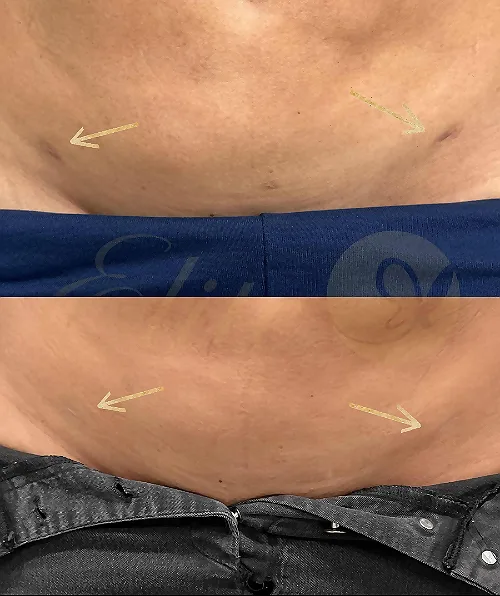
At Elite Permanent Makeup and Cosmetology College in West Los Angeles, paramedical consultations are free and private, so you can come in for an honest assessment even if you are not sure your scar is ready. The artist can tell you whether to book now or wait, and what a realistic outcome looks like. You can read more about our approach to scar camouflage for surgical scars or our earlier article on tummy tuck scar solutions in West Los Angeles.
Frequently asked questions
Can I book a consultation before my scar is fully mature?
Yes. An early consultation can help you understand what to watch for and roughly when to come back. The tattooing itself is usually best left until the scar is stable.
Will camouflage make my tummy tuck scar disappear?
No technique erases a scar. Camouflage aims to reduce color contrast so the scar is less noticeable. Texture, such as a slight ridge or indent, usually stays visible in certain lighting.
Does it matter if I tan?
Yes. The lower abdomen is often lighter than the rest of the body, and pigment does not tan. If that skin darkens in the sun, the camouflaged scar can look lighter by comparison, so sun protection helps keep the match.
What if my scar is darker than my skin?
Darker scars are generally not good candidates for skin-toned camouflage. A dermatologist may be able to suggest options for hyperpigmentation first.
Can camouflage cover scars from liposuction ports or drains?
Small, pale, flat drain or port scars can sometimes be treated along with the main scar, as long as they meet the same maturity checklist.