On this page
Short answer: Neither one is better for everyone. Laser treatment from a dermatologist is usually the stronger choice for newer red or purple stretch marks and for texture. Camouflage, which blends skin-toned pigment into marks, suits mature, flat, white or silvery marks where color contrast is the main issue. Neither erases stretch marks completely.
Why do stretch marks respond differently to different treatments?
Stretch marks are not just a surface blemish. Cleveland Clinic describes them as a form of scarring that appears when skin stretches or shrinks quickly and the collagen and elastin in it break. That is why they behave more like scars than like ordinary discoloration.
They also change over time. Early marks tend to be red, pink, purple or dark brown depending on skin tone, and can feel slightly raised or itchy. Mature marks fade to a paler, silvery or white color and often sink slightly below the surrounding skin. The American Academy of Dermatology points out that many treatments work best on early marks, and that while stretch marks are permanent, treatment may make them less noticeable.
So the question is less “camouflage or laser?” and more “what stage are my marks in, and what bothers me most: the color, the texture, or both?”
How does laser treatment for stretch marks work?
Lasers used for stretch marks fall into two broad groups. Some target redness in newer marks. Others, such as resurfacing and fractional lasers, create controlled injury to prompt the skin to build new collagen, which can soften texture over a series of sessions. These are medical procedures, typically performed or supervised by a dermatologist or physician.
Points worth knowing before you book a laser:
- It is usually a series. Improvement tends to build gradually over several treatments.
- There can be downtime. For resurfacing lasers, Cleveland Clinic notes recovery of about one to two weeks depending on the laser, with redness that can linger for months.
- Skin tone matters. The same source notes that people with darker skin have a greater risk of healing with darker pigmentation after laser resurfacing, so an experienced provider and test spots are important.
- It is generally not covered by insurance when done for cosmetic reasons.
How does stretch mark camouflage work?
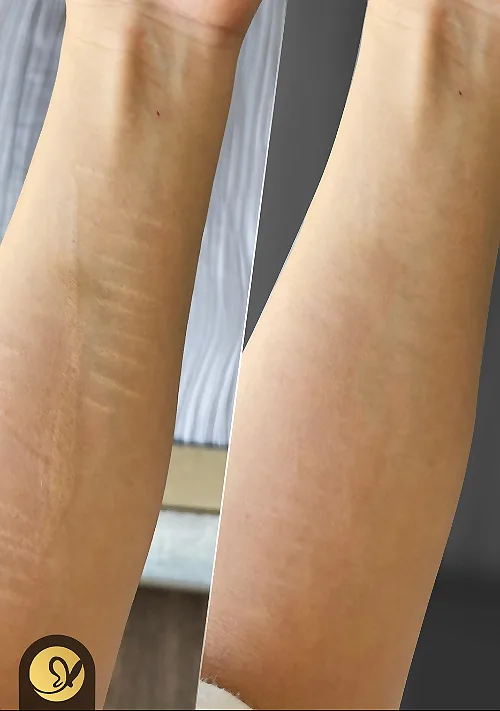
Stretch mark camouflage is a paramedical tattoo technique. The artist mixes pigment to match the skin next to the marks and places it into the pale streaks with a fine needle, building color gradually. When it heals, the marks contrast less with the surrounding skin, so they are harder to spot at a glance.
It is a cosmetic service, not a medical treatment, and its limits are specific. It works on color contrast, so it is best suited to marks that are lighter than the surrounding skin. Darker or purple marks are generally not good candidates. It does not lift indented marks, and because tattooed pigment does not tan, the blend can look different when the skin around it darkens in the sun. Elite’s longevity guide suggests stretch mark camouflage results can last roughly three to six years with proper care before a refresh, though this varies.
There is also a third option many people have not heard of: inkless stretch mark treatment, which uses a tattoo machine and a serum without any pigment to work on texture and tone. It is covered below.
Stretch mark camouflage vs laser: side-by-side comparison
| Factor | Laser (dermatologist) | Pigment camouflage | Inkless treatment |
|---|---|---|---|
| Main target | Redness or texture, depending on laser | Color contrast of pale marks | Texture and overall appearance, without pigment |
| Best stage | Often early, red or purple marks; some lasers for older marks | Mature, flat, white or silvery marks | Mature marks, at least 12 months old |
| Adds pigment? | No | Yes, skin-toned | No |
| Sun and tanning | Sun avoidance needed during healing | Match can shift when skin tans | Sun protection still advised |
| Typical sessions | Several | Usually more than one to build color | From one to as many as six, at least 8 weeks apart |
| Who performs it | Dermatologist or physician-supervised provider | Trained paramedical tattoo artist | Trained paramedical artist |
| Removes marks? | No; may make them less noticeable | No; makes them harder to see | No; aims to make them less noticeable |
Which option fits your stretch marks?
A simple way to think about it, before anyone examines your skin:
- Your marks are new, pink, red or purple. Start with a dermatologist. Camouflage and inkless work are generally meant for mature marks, and early marks often respond to medical treatment in ways older marks do not.
- Your marks are old, white or silvery, and mostly flat. Color is likely the main issue, which is where camouflage can help. Laser and inkless treatment are also options if texture bothers you.
- Your marks are mature but noticeably indented. Texture is the bigger issue. Laser or an inkless approach may suit better than pigment, which cannot fill in a dip.
- You tan easily or spend a lot of time in the sun. Be cautious with pigment camouflage, since the match can shift; pigment-free options avoid that particular problem.
- You have a history of keloids, are pregnant or breastfeeding, or have a skin condition in the area. Talk with your doctor before any of these treatments.
Some people use more than one approach over time, for example a dermatologist’s treatment while marks are still red, then camouflage or inkless work once they mature. Any combined plan should be discussed openly with both providers, and each one should know what the other has done.
What about creams and at-home treatments?
Creams are often the first thing people try. The AAD notes that some ingredients, such as tretinoin and hyaluronic acid, seem to help early stretch marks, but that treatment seems to have little effect on mature ones, and in-office procedures have proven more effective than creams and lotions. Retinoid products may not be appropriate during pregnancy or breastfeeding, so check with your doctor first. For older white marks, creams alone rarely change much, which is why people start comparing in-office options.
Exploring stretch mark options at Elite
Elite Permanent Makeup and Cosmetology College in West Los Angeles offers paramedical stretch mark services with free, private consultations. If your marks are mature and you would like a pigment-free approach, you can read about our inkless stretch mark treatment in Los Angeles. For the pigment route, our earlier guide to stretch mark camouflage techniques explains more. If your marks are still red or changing, we will tell you honestly that a dermatologist is the better first stop.
Frequently asked questions
Is laser or camouflage more painful?
Both involve some discomfort, and it varies by person and area. Laser providers use their own cooling or numbing methods. For camouflage, a topical numbing cream is used, and most clients describe it as uncomfortable rather than painful.
Can I have laser on marks that were already camouflaged?
Tell any laser provider if the area contains tattoo pigment. Lasers can interact with pigment in unpredictable ways, so they need to know before treating.
Do stretch marks fade on their own?
Many become less noticeable with time as they change from red or purple to paler marks, which is part of why waiting for marks to mature matters before camouflage.
How do I know whether my marks are mature?
Mature marks have usually lost their red or purple color, look silvery or white, and have stopped changing for some time. An in-person look at a consultation is the most reliable way to judge.