On this page
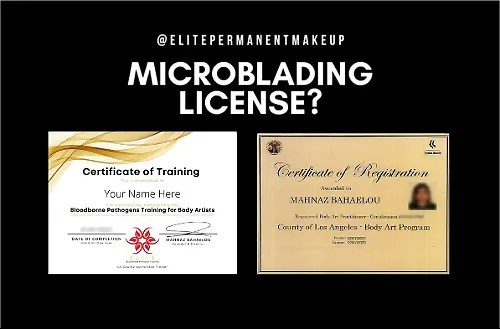
Short answer: In California, the credential that legally matters for microblading is body art practitioner registration with your county health department, backed by yearly bloodborne pathogens training and hepatitis B vaccination records. A school’s course certificate proves you were trained, but it is not a license. Its value depends on the school’s oversight and hands-on teaching.
Is there a state microblading license in California?
People often search for a “microblading license” expecting a single state card, like a driver’s license. California handles it differently. Under the California Safe Body Art Act, permanent cosmetics, which include microblading, are classified as body art alongside tattooing and piercing. The Act says a person may not perform body art unless they are registered with the local enforcement agency, which in most of the state means the county environmental health department.
In Los Angeles County, the Department of Public Health body art program explicitly names microblading and micropigmentation as permanent cosmetics, requires each practitioner to register with the county, and requires businesses to hold a public health permit to operate. So the answer to “who licenses microblading artists in California” is, in practice, your county.
Which certificates and registrations will you actually need?
New artists collect several documents, and it helps to know which ones carry legal weight:
| Credential | Who issues it | Required to practice? | Renewal |
|---|---|---|---|
| Body art practitioner registration | County health department (local enforcement agency) | Yes | Every year |
| Bloodborne pathogens training certificate | A trainer approved by the local agency | Yes, to register | Annual update |
| Hepatitis B vaccination record (or proof of immunity or declination) | Your healthcare provider | Yes, to register | Boosters as applicable |
| Proof of age (18 or older) | Government ID | Yes, to register | Not applicable |
| Microblading course certificate | The school that trained you | Not by itself; it documents training | Not applicable |
| Public health permit for the workplace | County health department | The facility you work in needs one | Per county rules |
Requirements are set by statute and carried out by each county, so details such as forms and fees vary. Always check with the county where you plan to work.
Why does bloodborne pathogens training matter so much?
Microblading breaks the skin, which brings a real risk of spreading bloodborne infections such as hepatitis B and C if hygiene slips. The Safe Body Art Act addresses this directly. Before registering, practitioners must complete bloodborne pathogens exposure control training of at least two hours, taught by a trainer approved by the local enforcement agency, and complete at least two hours of update training every year.
This is why Elite asks every student to complete an online bloodborne pathogens course, about 3 hours, before the first day of class, and to renew it every year. You can read more on Elite’s California BBP certification page. Keep your certificate somewhere easy to find, because you will need it each time you renew your county registration.
What does a school certificate prove, then?
A certificate of completion tells clients, employers and salon owners that you finished a structured course. It does not replace county registration, and a beautifully printed certificate from a weekend class means little if the training behind it was thin. When you weigh a school, look at what the certificate represents:
- Hours of instruction. Was it a single day of demonstrations, or several days of hands-on practice?
- Live model work. Did you complete a supervised procedure on a real person?
- Who taught you. How experienced is the instructor, and how much individual correction did you get?
- School oversight. Is the school approved by a state agency?
Be cautious with any course that promises you will be “licensed” the moment you finish class. No school can issue your county registration for you; at most, it can help you prepare and submit it. Likewise, be wary of programs that skip the live model entirely or cannot tell you who will be teaching. A clear, honest answer to those questions usually says more about a school than the design of its certificate.
That last point is easy to check. California’s Bureau for Private Postsecondary Education oversees private postsecondary schools, reviews their programs and operating standards, handles student complaints and helps students affected by school closures. A school approved by the Bureau has agreed to that oversight, which protects you as a paying student.
Do certificates from other states or online courses count in California?
A course certificate is portable in the sense that it documents your training wherever you go, but registration is local. If you trained elsewhere and want to work in Los Angeles, you still need to meet Los Angeles County’s registration requirements. The reverse is also true: Elite’s course page notes that out-of-state students register in Los Angeles to work on their course model, and then need to register in their home county before seeing clients there.
Online courses can be useful for theory, and the bloodborne pathogens requirement itself is commonly completed online through an approved provider. Microblading technique, though, is a hands-on skill. A certificate from an online-only technique course will not give you the supervised practice on real skin that clients and salon owners look for. Elite’s page on learning microblading online covers where online study fits.
How do you get registered in Los Angeles County?
The broad sequence for a new artist looks like this:
- Complete bloodborne pathogens training from an approved provider.
- Gather your hepatitis B vaccination records, or talk to your doctor about vaccination or proof of immunity.
- Have your ID ready to show you are 18 or older.
- Submit your registration with the county health department.
- Work only in a facility that holds the required public health permit.
- Set a reminder to renew your registration and bloodborne pathogens training every year.
For students, Elite can take care of the county registration step for an added $100, renewed annually. This matters during training too, because you need to be registered before you work on the live model. Elite’s microblading license guide goes through the Los Angeles steps in more detail.
Training for the credentials that count
Elite Permanent Makeup and Cosmetology College has trained permanent makeup artists in West Los Angeles since 2012, is approved by the Bureau for Private Postsecondary Education, and is described on its site as the first microblading and permanent makeup college approved by the State of California. The 5-day microblading certification course costs $3,000 with a starter kit and live model day included, and the school helps students with county registration so the paperwork and the training line up.
Frequently asked questions
Do I need to be an esthetician to do microblading in California?
The Safe Body Art Act ties permanent cosmetics to body art practitioner registration with your county, not to an esthetician license. Elite’s microblading course is open to beginners with no prior license.
How much does county registration cost?
Fees are set by each county and can change, so check the current amount with your county health department. Elite offers to register its students in Los Angeles County for an added $100, renewed annually.
Can I practice microblading from home?
Body art must be performed in a facility that meets county health requirements and holds a permit. Whether a home studio can qualify depends on county rules, so ask the health department before you invest in a space.
Does my registration expire?
Yes. Practitioner registration must be renewed every year under the Safe Body Art Act, along with your annual bloodborne pathogens update.
Is an “international” or “master” certificate worth more?
Titles on a certificate matter less than the training behind them. Ask how many hours of hands-on practice and live model work the course includes, and whether the school is state approved.